
Graph Contexts
Different graph types are designed for different scenarios.
In Divooka, there are eight graph types (also called graph kinds), in three contexts and a family for defining types:
- Dataflow contexts: Flows, Function, Components (formerly System)
- Procedural contexts: Events, Routine
- Declarative contexts: StateMachine, Constructs
- Type definition: Type (formerly Struct)
| Graph type | Context | What it is | Divooka Explore | Divooka Compute |
|---|---|---|---|---|
| Flows | Dataflow | A free-form canvas: values travel along wires, and a run executes the nodes marked active and everything they depend on. | Create, edit, run | Create, edit, run |
| Function | Dataflow | A graph other graphs call like a node, with one Input node and one Output node. | Create, edit, run | Create, edit, run |
| Components | Dataflow | An object defined as a dataflow: every output nothing else takes becomes a field of the object, and making one is what runs the graph. | Open and run | Create, edit, run |
| Events | Procedural | Callbacks an application framework calls, such as Start and an update on every frame. | Create, edit, run | Create, edit, run |
| Routine | Procedural | Steps in order along execution wires, with loops and branches. | Create, edit, run | Create, edit, run |
| StateMachine | Declarative | States joined by named transitions, each guarded by a condition. | Open and run | Create, edit, run |
| Constructs | Declarative | An object tree assembled from constructors and factories, with no side effects. | Open and run | Create, edit, run |
| Type | Type definition | A data structure of your own, with data members and Function or Routine graphs as its methods; it is not run on its own. | Create, edit | Create, edit |
Divooka Explore creates Flows, Function, Events, Routine and Type graphs; it can open and run a document that holds Components, StateMachine or Constructs graphs, but does not offer to create them. Divooka Compute offers all eight. The editors show a graph's kind and its family above the canvas, for example Flows · dataflow. See the guides to graphs in Divooka Explore and graphs in Divooka Compute.
Older documents and pages may use the former names: System for Components, and Struct for Type (a Type can still be a Class, a Struct or a Record, chosen in its properties).
Dataflow vs Procedural Context

Learn more:
Mixing Dataflow Context in Procedural Context
One must be very careful as to graph state when mixing dataflow nodes in procedural context, as illustrated in the below example:
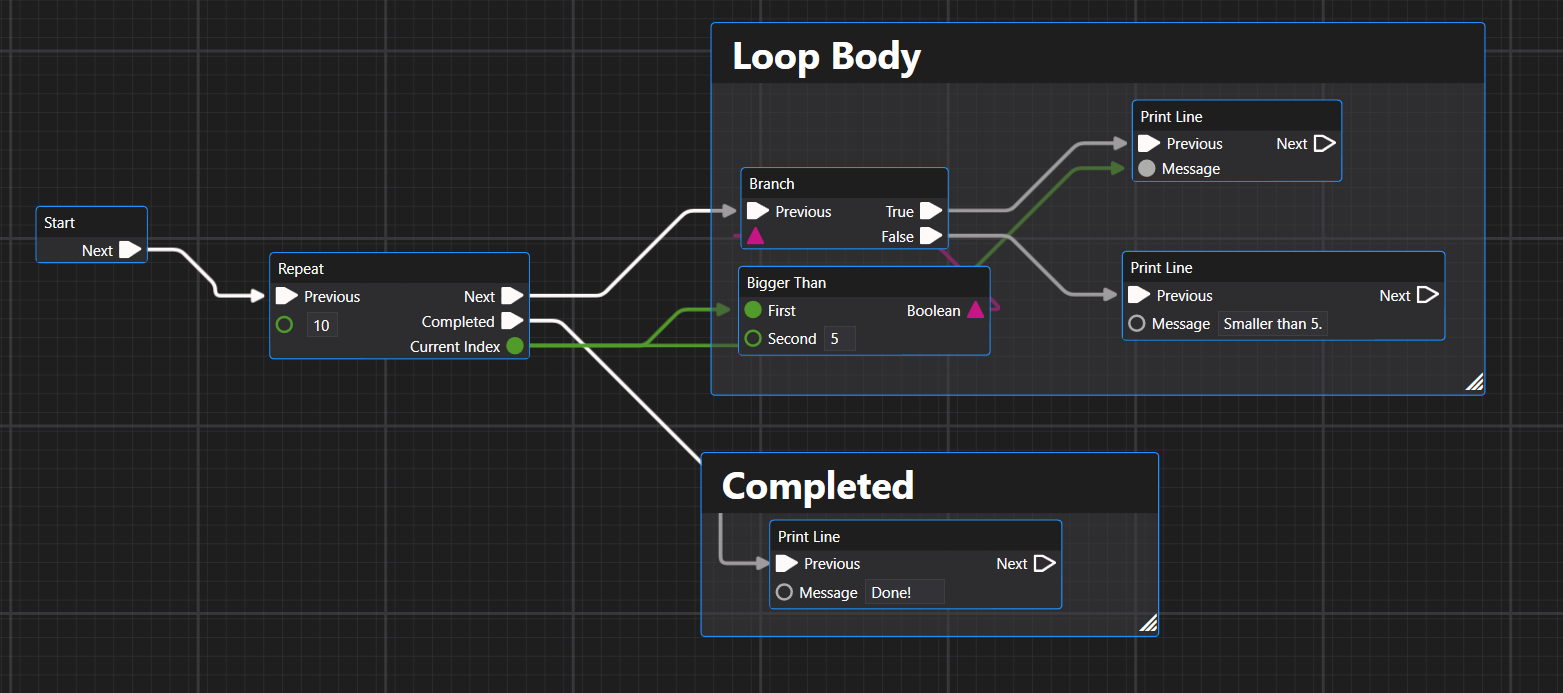
The Bigger Than computation is going to be evaluated twice: once per Repeat node, the other per Branch node. This is not standardized behavior and generally produces "undetermined" results.
Declarative Contexts
In a declarative graph the nodes describe something rather than computing it step by step. A StateMachine joins states by named transitions, each guarded by a condition: each state's behaviour is a graph of its own, and a run enters the first state, runs it, and takes the first transition whose condition holds. A Constructs graph is an object tree assembled from constructors and factories, with no side effects; it is a description other graphs read. Learn more: Declarative Contexts.
Modules
Module defines member data and member behaviors. In Divooka, each graph (no matter which type/context) is actually a module.
Types
The dedicated Type graph allows defining your own data type: its data members, and Function or Routine graphs as its methods. Other graphs make an instance of it with its Make node and read and set its members. A Type is not run on its own; use Function and Routine graphs for logic.