
Class Diagrams
A class diagram is classes, what they hold and what they do, and how they relate. It starts with class and its title.
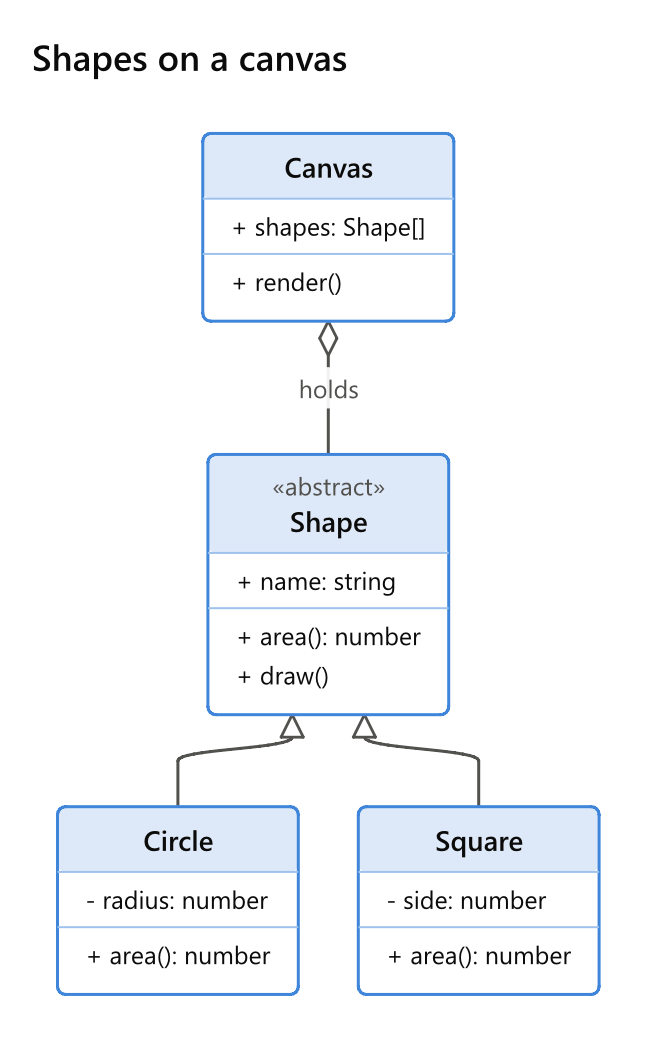
class Shapes on a canvas
Shape [abstract]
  + name: string
  + area(): number
  + draw()
Circle
  - radius: number
  + area(): number
Square
  - side: number
  + area(): number
Canvas
  + shapes: Shape[]
  + render()
Shape <|- Circle
Shape <|- Square
Canvas o- Shape: holds
Settings
| Setting | Also | Value |
|---|---|---|
direction |
flow, orientation, layout, rankdir |
down (the default), right, up or left |
Classes and members
A class is named on a line of its own - class Name is the same - with its members indented under it. A member with brackets is an operation and goes in the class's second compartment; any other member is a field.
A member starts with its visibility, as a symbol or a word:
| Symbol | Word | Visibility |
|---|---|---|
+ |
public |
public |
- |
private |
private |
# |
protected |
protected - written as the word, since a line starting with # is a comment |
~ |
internal, package |
internal |
static before a member underlines it and abstract sets it in italic: static count: number, abstract deposit(amount). A member that belongs to no class - written at the top rather than under one - is said.
Stereotypes
A word in brackets after a class that is not a colour, a role or muted is the class's stereotype, shown above its name: [interface], [abstract], [enum], [record], [service] - any word you need.
Relationships
The plain arrows draw associations and dependencies - Order -> Customer, Report ..> Printer - and UML's ends, written with a space on each side, draw the rest:
<|-,<|--,-|>,--|>- inheritance: a hollow triangle at the more general class.<|..,..|>- realisation: a dashed line with a hollow triangle at the interface.*-,*--,-*,--*- composition: a filled diamond at the whole.o-,o--,-o,--o- aggregation: a hollow diamond at the whole.
The more general end of each relationship - the base class, the interface, the whole - is laid out above the other. A label goes after a colon: Canvas o- Shape: holds.
A line with a count at each end writes multiplicities: Bank 1-* Account. Each end is 1, 0..1, 1..* (also 1..n) or * (also 0..*, n, many).
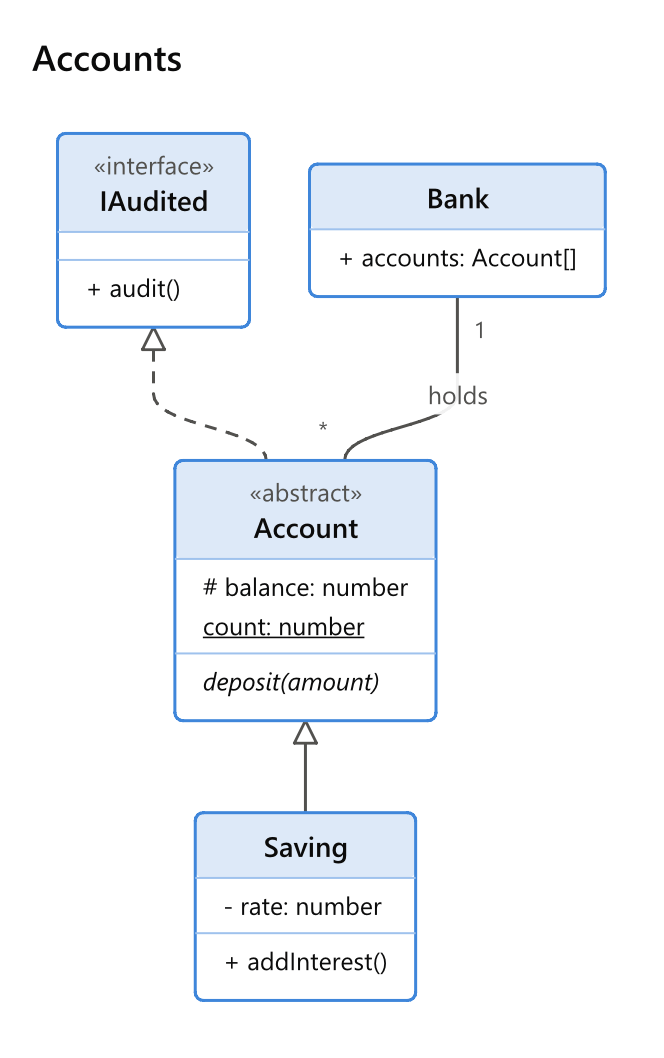
class Accounts
Account [abstract]
  protected balance: number
  static count: number
  abstract deposit(amount)
Saving
  - rate: number
  + addInterest()
IAudited [interface]
  + audit()
Bank
  + accounts: Account[]
Account <|- Saving
Account ..|> IAudited
Bank 1-* Account: holds
Packages and notes
package Name - also namespace or group - frames the classes indented under it. note Class: what to say puts a note beside a class.