
Tables and Boards
Tables
A table starts with table and its title, and its rows are written as Markdown writes them:
table Opening hours
| Day | Opens | Closes |
|-|:-:|-:|
| Monday to Friday | 9:00 | 17:30 |
| Saturday | 10:00 | 16:00 |
| Sunday | closed | closed |
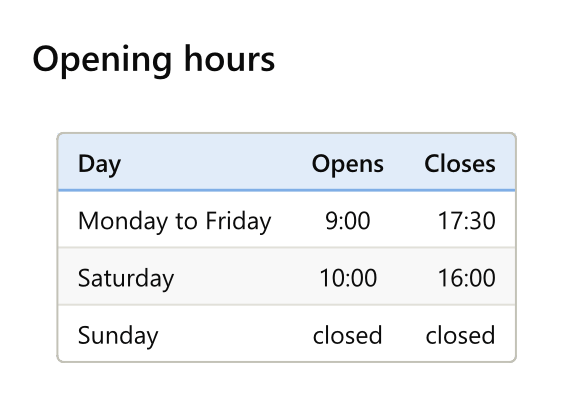
- Cells go between bars. The first row is the header.
- A line of dashes under the header says how each column lines up:
:-on the left,:-:in the middle,-:on the right,-as its values suggest. - Rows can also be comma-separated values, the first row the header -
Name, AgethenAnn, 40- with a cell holding a comma put in quotation marks. The first Dhole'sheaders: Name, Gender, Ageis read too.
Each column is as wide as its widest cell, and numbers line up on the right unless the line under the header says otherwise. A row with more or fewer cells than the header is warned of, and drawn with the cells it has.
Boards
A board starts with kanban - or board - and its title. The lines at the top are its columns, and the lines indented under a column are its cards:
kanban This week
To do
  Write the report
  Book the hall [warn]
Doing
  Draw the plan [blue]
Done
  Order the chairs [good]
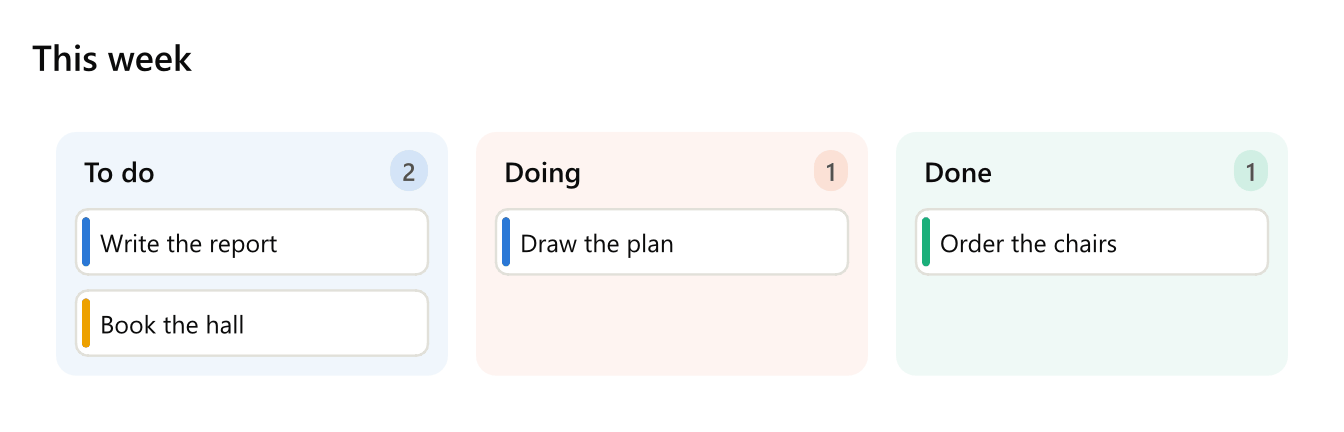
A colour or a role in brackets after a column's name colours the column, and after a card's the card's stripe. The columns stand side by side, each headed by its name and how many cards it holds.
Write Dhole's example keeps a board on the node - see the tutorial.