
Entity Diagrams
An entity diagram is the tables of a database and how their rows relate. It starts with entity and its title.
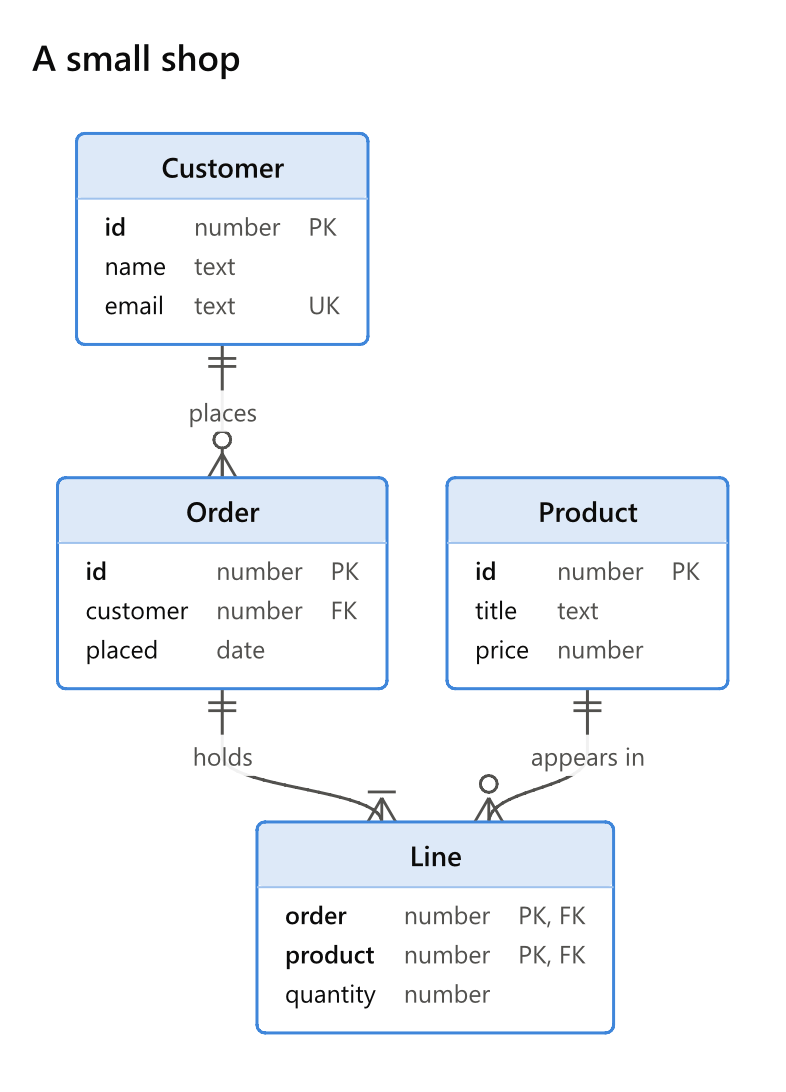
entity A small shop
Customer
  id: number [key]
  name: text
  email: text [unique]
Order
  id: number [key]
  customer: number [ref]
  placed: date
Product
  id: number [key]
  title: text
  price: number
Line
  order: number [key, ref]
  product: number [key, ref]
  quantity: number
Customer 1-* Order: places
Order 1-1..* Line: holds
Product 1-* Line: appears in
Settings
| Setting | Also | Value |
|---|---|---|
direction |
flow, orientation, layout, rankdir |
down (the default), right, up or left |
Entities and attributes
An entity is named on a line of its own, with its attributes indented under it. An attribute is a name, a colon and a type, then its keys in brackets:
| Key | Also | Shown as |
|---|---|---|
key |
pk, primary, primary key, id |
PK, and the name underlined |
ref |
fk, foreign, foreign key, reference |
FK |
unique |
uk |
UK |
id number - a name and a type without a colon - is read as well. A name, a colon and a type written outside an entity is said: it belongs indented under one.
Relationships
A relationship is a line with a count at each end, drawn as crow's feet: Customer 1-* Order: places. Each end is one of four:
| Count | Also | Means |
|---|---|---|
1 |
exactly one | |
0..1 |
zero or one | |
1..* |
1..n |
one or more |
* |
0..*, 0..n, n, many |
any number |
The ends are joined by one, two or three dashes, and a label goes after a colon. Mermaid's crow's feet drawn in characters are read too: ||--o{ is one to any number, |o--|{ zero or one to one or more, and two dots in place of the dashes - }|..|| - draw the line dashed, for a relationship that is not identifying. A count no end can have, such as 2-*, is said.
The plain arrows draw plain lines between entities.
Groups and notes
group Name frames the entities indented under it. note Entity: what to say puts a note beside an entity.